Wednesday, October 06, 2010

Decorating Your Home And Garden For Fall

Many years ago, when summer was over I yanked all of my drooping flowers out of their containers and put out some Indian corn, cornstalks and pumpkins on my front porch.  The pumpkins were always eaten and tipped over, the corn was chewed to the bone and it looked pretty sad by Halloween.


The Reggie dog was quite perplexed by this huge arachnid on the railing going upstairs.  I am surprised that he did not go after it!  This one has no eyes, but did you know that some spiders do not have any eyes?

Halloween used to be my favorite holiday because even though I was working full time with two children I had the neighborhood party.  We rented movies from the library and I made food ahead of time for the freezer so that everything would be ready for the big day.


These are great, I don't want to light them because then they will be gone.  I believe I got these at Target a few years ago.


Faux is becoming much more real.  These are faux gourds, achilliea, pears, pumpkins and little birds.  The pumpkins, gourds and pears are from Pottery Barn all arranged in an antique etched container.

Decorations now are over the top, lights, mummies, ghosts ringing the trees,talking vampires and witches the lawn ornaments and the celebration goes on for over a month.  I have given up on the real pumpkins, so I use the type you buy at a craft store, sprayed with marine varnish, and some are ceramic.  The pumpkins and gourds look so real now, there is no reason not to decorate containers and window boxes.  Long picks can also be purchased to stick through the decorations and anchor in the soil.


Indoors I can use real pumpkins and gourds mixed with faux flowers.

Reggie hasn't found these spiders yet!


I went to my daughter-in-law and son's home and found these people on their front porch, drinking Starbucks!

Believe it or not, I found this spooky person at the front door!

How would you like to find this in your garden?

Don't be concerned about using faux with real.  My situation is squirrels, so my quest each year is to find pumpkins that look either very decorative or real.  Each year it has become easier to find gourds and pumpkins that mimic the real thing.  Another faux acceptable is grasses because the real thing will collapse and wilt in your containers.


Halloween is still a favorite (not the Trick-Or-Treating as my dog goes crazy) with a family party and optional costumes.

Halloween is the second biggest decorating holiday in the United States next to Christmas!

Monday, October 04, 2010

First Impressions

First impressions really do count not just in our personal connections but with the appearance of the front facade of our home.  We read a great deal about focal points, and they are important, but we talk very little in regard to how our home looks to one who is passing by walking or in a car.


This is a great entrance to a 1921 home that has been renovated inside and out.  The urn as a focal point stops the eye for a moment but then you are brought on up to the front door.

Urn as a focal point on the walk


Hayrack on the gate at the side of the home

A big turn off for me is a guessing game when it comes to the location of the front door, sometimes there are homes with two front doors, which one do I go to?  Manytimes, there are so many plantings that the front door is obscured.  I know there are people who prefer a private effect (like Frank Lloyd Wright who had his front door on the side of the house rather than the front).

This is a large home with lots of landscaping, but there is still a pathway leading up to the front door which is visible from the street.

This stone pathway leads up to the front door on an angle.

Even though the lot is heavily planted, there is a full view of the front door from all angles.

This is a view of the lower level plantings on this lot, your eye is constantly taken up until you reach the front door.

Again, this home has many plantings, but the front door is left free for the eye to lead you there.

If you can imagine, this picture does not do the landscape justice, since the perennial gardens go all the way around the house, too bad about that crocked stop sign, but the owners have planted on property owned by the village.

This is a home I constantly watch through the seasons, all those mounds you see are mums.  See, I am not too bad about buying mums compared to this!  Notice the clear pathway to the front door.

This is a very large home with expanses of Limelight Hydrangea on each side of the front walk.  I have one Limelight, so I was blown away by the expanse of these hydrangeas used as a hedge on each side of the walk.

This was a stunning look with plantings flanking the walk and then diverse plantings on each side of the front door.

I have determined that I do not have the lot width to do plantings this far down on my walk (at least this is what my husband thinks) but it does give me ideas on how to handle the plantings on the sides of the walk.

I really am going to remove those thorns from the front of my house (roses) and redo with some interesting evergreens, perennials and annuals.

Thursday, September 30, 2010

The Goodbye Garden

You probably know by now I like movies, old movies, some new movies and those old horror movies with Bela Lugosi.  I looked around my garden today and everywhere I looked it was saying goodbye!  For some strange reason it reminded me of a favorite movie called The Goodbye Girl with Richard Dreyfuss and Marsha Mason.

I cut the Henryi Type 2 Clematis to the ground this year because it had become very woody.  It has grown quite tall and is putting out one huge bloom to say goodbye.

Comtesse De Bouchard has lots to say as a type 3 if we don't get a frost.  Look at all of those insect bites, many more than during the spring and summer.

Duchess of Albany is a type 3 saying goodbye with just one bloom.  Again, it is being eaten by insects.

Miss Bateman type 2, you have come back, so nice of you to visit before going to sleep even if is only one bloom!


The Rhodies will develop some reddish colored leaves, not to worry, this is normal for this time of year.  They will drop these leaves but will be perfectly healthy for new growth in the spring.  Remember when it gets really cold or really hot their leaves curl under.

I am finding it difficult to say goodbye to my Pineapple Coleus (which has become more veined as the weather has cooled) and the Pink Knockout Rose.  My rose has not made an appearance in two months, but it has come to say goodbye.


The tuberous begonias have done well all summer, I will certainly bring more of these into my garden next year.


The Volcano Phlox Pink with White Eye is blooming even after a traumatic hot summer planting.


This petunia has done nothing all summer, I have even forgotten its name, but now it is making a last hurrah!


The Italian parsley will hold up until November.  It takes a really hard frost to take parsley out.

Ursula

Andrea orange mum and unnamed yellow cultivar


Unnamed yellow cultivar (I know I said I wasn't going to buy so many mums but I couldn't resist)


The pansies are beginning to fill out with the cabbages and red swiss chard.

Bright Lights Swiss Chard (the lights are the stems not the leaf)

Plumbago under the Arnie's Choice daylilies (this experiment worked in regard to having something that is growing under the daylilies after they are cut down in July)


Let's Dance is a new lace cap hydrangea that has suffered this summer with the heat.  It is now putting forth many new buds.  We'll see you next year!


The back border will soon be gone with the first frost.  Goodbye!

I am concerned about saying hello to anything in the next few months.  It has been so intensive during the spring and summer months, we need to figure out our discussions for those cold winter days!

I like Larry Conrad's idea about developing a forum for discussing what worked for us and what didn't and maybe coming up with some ideas for a better 2011.


Monday, September 27, 2010

Bulb Planting Time Is Here

My serious garden club met last week and had a serious workshop on fall bulb planting.  The person who spoke is a purchaser and bulb expert for a local nursery.  She was very knowledgeable and so excited about her favorite seasonal bulbs.

Itzim

This is one of my favorite early daffodils.  It is similar to Tete-a-Tete but blooms for a much longer time period.

One of her favorite bulbs is Allium Schubertii  which is so large I asked what she did with the leftover spiked dried blooms.  She says friends of hers spray paint them white like snowflakes.

Allium Schubertii

When planting tulips beyond the species tulips it is recommended that they be planted 10" deep in our area (zone 5) to increase chances of them returning the following year.  I have to admit that I rarely plant anything this deep and do not count on my tulips coming back.  I have had better luck with the Emperor variety but they do not return with their typical large blooms. 

As far as rabbits are concerned, she told us if we walked over the area we had just planted it would erase the scent of the bulbs.  I'll try this, but it sounds too simple!  I have used chicken wire with plant stakes (this definitely works) and a granular product called Plantskydd for Critters (this product works well on the squirrels who are the main bulb diggers in the fall - works also on the rabbits in the spring but not as well on the babies who do not mind a bad smell).


Orange Emperor Tulips

Soil is a major factor in regard to tulips being return visitors, it must be rich  and loamy, not solid clay, with some bulb fertilizer mixed in (Espoma Bulb Tone was her recommendation).  Throw a little in the planting hole, mix with soil or put a little on top of the soil after planting and filling the hole.  Tulip leaves should be left on the plant until they turn yellow or pull out of the soil easily.

Daffodils are another story, they are not quite as fussy but do benefit from being fertilized.  If your daffodils have ceased blooming profusely then they need to be divided.  They form many bulblets around the main bulb and just send up leaves and maybe one flower.  I had to divide Mount Hood last year and am not sure what to expect his year in regard to bloom.  When done blooming, daffodil leaves should be left standing, not braided, tied, cut or buried under dirt or mulch.  I have gotten much better about overplanting bulbs with plantings that cover the bulb leaves. 

Mount Hood Daffodil

Hyacinths are also prone to splitting into several florets instead of that compact large bloom when they are newly planted.  Our presenter said that this is also due to them not being planted deep enough.  I am afraid I am a big offender of the not deep enough crowd.  I guess I am too lazy to dig ten inches deep!


In order to have a good start for bulbs the soil needs to be cooled down to 60 degrees before planting.  I am not always planting in regard to soil temperature as I plant when it is comfortable for me to be working outside.  It has never been a problem in regard to bloom whether I plant in September or December (you can plant bulbs up until the ground is frozen)


Early Sensation Daffodil (blooms very early and for about three weeks)

Amaryllis and Paperwhites were dealt with briefly and no mention was made of the Christmas variety which blooms earlier than any of the regular amaryllis.  Check all of these bulbs out on http://www.johnscheepers.com/ and http://www.vanengelen.com/ 

Our presenter recommended that the amaryllis bulbs be saved from year to year for rebloom.  After the plant is finished blooming she said to let the leaves grow for awhile and then cease watering and put in a dark area.  When you notice that green tip beginning to form again at the top of the bulb, then it is time to begin watering again and give the bulb some light.  It was recommended that the amaryllis be planted in good potting soil half way down with the other half of the bulb out of soil.  Amaryllis will also grow in pebbles and water but for holding over for rebloom soil is a better medium.  Paperwhites are a one-time bloom plant, enjoy and throw away.


Christmas Amaryllis (There are many colors to choose from)


Paperwhites Ziva

If you live in a southern climate many bulb companies will ship pre-cooled bulbs.  Happy planting!

Friday, September 24, 2010

Around The Garden

I can't believe another week has gone by.  I am noticing many changes in our weather even though it has been very warm.  The leaves are whirling with many already on the ground, my faux pumpkin blew down the alley (not heavy like a real one) forecasting a changing temperature over the next few days.  Our highs are predicted to be in the sixtys rather than eighties.

The Sweet Autumn Clematis is lovely on the pergola and has not even fully opened yet.  The wind has blown many of the petals all over the patio.  I watch this grow over the summer with not a bloom on it, it shades the patio, and when it blooms it is well worth the wait.  I am going to cut it down in the fall this year just to get all of this off the pergola.  We'll see if it survives, have cut other type 3's down in the fall and they have been fine.


With the first frost the coleus will be gone.  Coleus has been one of my best performers this year becoming  wilted with the high heat but always bouncing back with a little water.


Inky Fingers intertwined with Bronze Sweet Potato Vine amongst the boxwoods, always does well in this environment.


This is a section of the alley garden that shows most of the plants growing there, just repeating as you travel the approximately thirty foot length. 


This is Agastache Blue Fortune, very fragrant and usually covered with bees.  It is not a problem in the alley but I would not recommend it for anywhere where you pass by often.  Next to it is Sedum Autumn Fire, supposedly a replacement plant for Autumn Joy.  However, it's color is not as vibrant, flower heads not as big, but it does not flop and stands through the winter.


Perilla is a wonderful plant to fill in the border.  It is an annual in my area and related to the coleus.  It can get to be about four feet high and has a stronger stem and leaf structure than coleus.


Diamond Frost Euphorbia pairs very well with roses and allysum.  It is fairly cold hardy but will succumb to frost.  It has been recommended to plant with pointsettas but you will have to pot it up and bring it inside if you are in an early frost area.


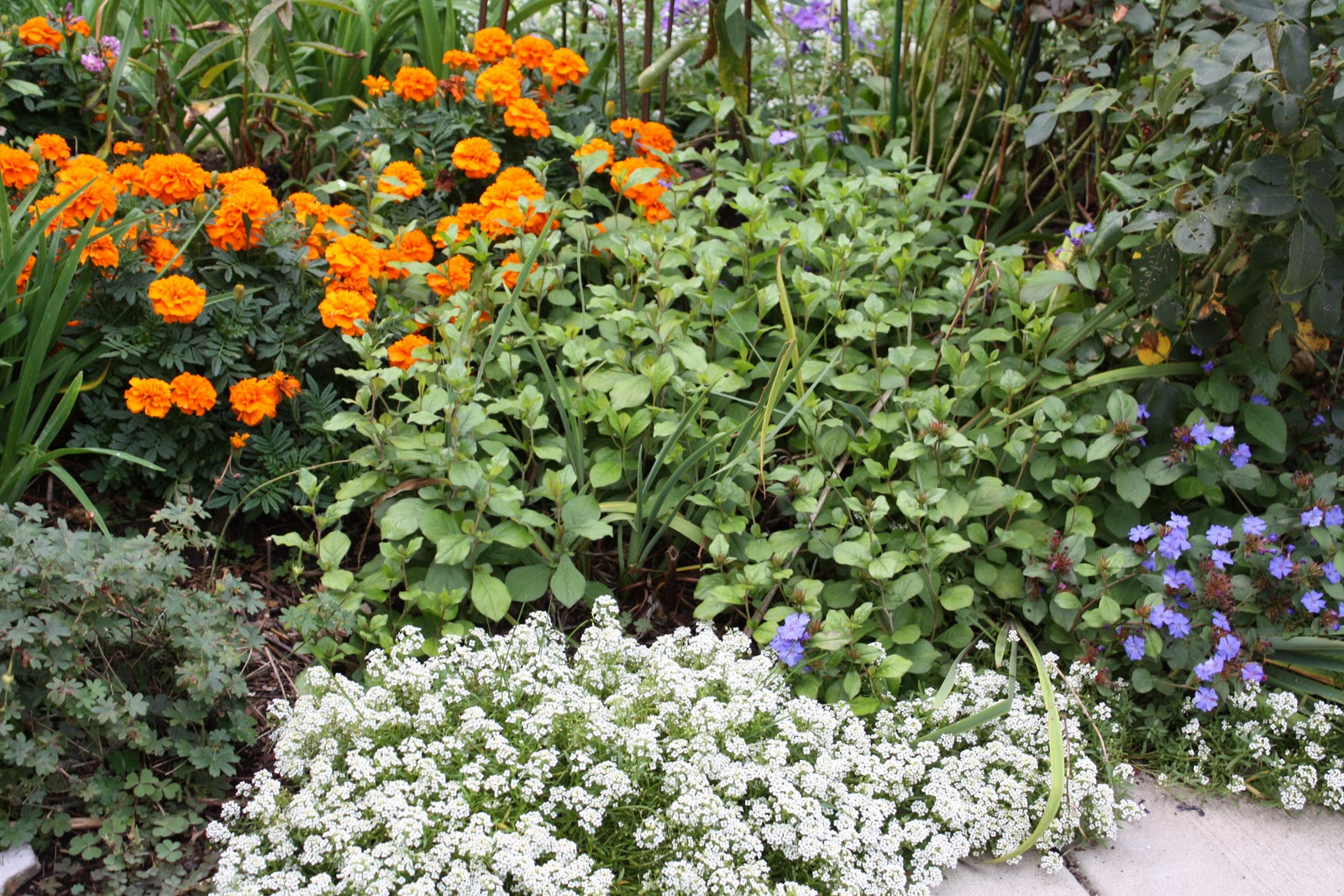
After Becky Shasta was done blooming and cut down the Plumbago took over and I did add some marigolds.  I am redoing this garden, less Beckys and more phlox and daylilies.

Purple Dome Aster is just beginning to bloom.  The rabbits really did a job on this in the spring and I thought it would never bounce back.  It has really filled out because the rabbit pruning.

I have already cut many flower heads of Limelight Hydrangea and have more to cut over the weekend for drying.  I will leave some to winter over and turn a light tan in the winter.

I will also be cutting some of the plums of Miscanthus Udine for indoor decorating.  They turn a beautiful pink as the weather cools.  This is not a grass that I would recommend be left standing for the winter, however, it is very difficult to cut it down when it looks so beautiful.  Last year I left it and it was a major chore to cut down when flattened by the snow.

Panicum Northwind is a great grass to leave standing over the winter.  It will turn a light tan and even with snow will pop back up when it melts.  It is usually about March when you will notice it is not as upright, but this is okay, it's almost spring.


Variegated Solomon's Seal is a plant that has held up through the seasons and the heat.  It is a fast multiplier and loves a shady or partly shady area.

There is a great deal of work to be done in the garden this time of year.  When I wait too long it is miserable trying to work outside trimming and cutting.  I am trying to keep ahead of this, knowing that if I don't pull some things out early it will be difficult to do this in a few weeks.