Monday, June 11, 2012

A Collector's Garden 2012

I am back at my sister-in-law's eclectic garden and there are always new (old) things to see.


The pond is the highlight for me since I would love a pond but just do not have the room.  It is a vintage cement pond.

Persicaria Polymorpha at the back of the pond is secured in place with an old wooden headboard.

The Coreopsis Zagreb does very well in this full sun area and with shearing back should produce another round of blooms.

An old piece of fencing and some garage sale faces will hold up the pole beans.

Some more little people peeking out of the sedum


The geese used to be dressed when they belonged to my sister-in-law's mother but now hosta will do!

Old tools hanging over the vegetable garden

Grass growing up through a small vintage bike

Old popcorn popper with colored eggs

An old stove with an angel watching
Supposedly it was used by my mother and aunt to make starch, hooked up to a gas line in the basement.

Fencing is a great way to identify different rooms and uses in your garden.

The arbor has Autumn Clematis growing on it which will bloom in August and September.

I just love those birds!

I have come to the realization that most of the containers we use are too small.  This is a new one on the front porch area, looks very large doesn't it?

However, when you back up, let's say to the middle of the street, the container is seen in a new perspective, not too big at all.

Blue is a favorite color in this garden.


A memorial garden for a treasured mother
The daylilies I bought for this garden are called Addie Branch Smith.

Seating is important in a garden whether it is real or imagined.


Handmade  garden decor abounds.

Cup and saucer on a garden stake

 
Terra Cotta Pottery with Mexican tiles applied all around

I leave you with some views of the pond and the borders.


Hopefully, this is not a plan but an inspiration!


Thursday, June 07, 2012

Growing Up

Clematis are as great for a small garden as they are for an estate, take up a small amount of planting space and reward with beautiful blooms all reaching skyward.

Comtesse De Bouchard (Type III) rated as excellent by the clematis experts.

Miss Bateman (TypeII)
I thought Miss Bateman was gone, growing on the same trellis as Henryi, but it is back maybe not as prolific as I remember but it is still here!

I am really learning to appreciate all types of clematis because they each have their own attributes and rewards.

Rouge Cardinal is a wonderful Type III but I have too many of them and I need to branch out and replace them with some other more unusual varieties.

I love the super blooms of the Type II's and the ease of care of the Type III's.  I don't own a Type I but the care is similar to Type II.

Konigskind Clematis (Type II)
I think I had identified this previously as General Sikorski.  Konigskind is a shorter clematis and works well on a small trellis.

I have found that if you cut down a Type II after blooming in the spring it will produce lush new growth and bloom a little later the next spring with gorgeous new blooms and no dead bottom wood.

Fireworks and Bee's Jubilee

Fireworks On Other Side
Fireworks weaves through and covers both sides of the grid, some tying necessary to train in early spring.

I have also found that if I cut down my Type III's in the fall it does not affect the bloom the following year.  I have done this three years in a row on my front clematis because I do not like the way the dried vines look all winter.  I cut them down in late October or November so there is little chance of new growth.

Hagley Hybrid (Type III)

Hagley Hybrid is great for part shade as it keeps its color better than in full sun.

I also cut down my Autumn Clematis after it has bloomed because when dried the following spring it is full of pollen that flies everywhere.  Since I have two separate clematis growing on the pergola it is important to have it clean for the Type II that will bloom in the spring.

Some clematis can be treated as more than one type, like Ernest Markham.  It has produced many more blooms when I treated it as a Type II rather than the Type III it was marked.

Ernest Markham (Type II or III)

I am going to experiment with some new clematis for next year and give some of my duplicates to my daughter.

Clematis need to be fed, some are heavier feeders than others.  I work in a 5-3-3 granular organic in the early spring and this has made a huge difference in regard to blooms.

Sunday, June 03, 2012

A Rose Is A Rose

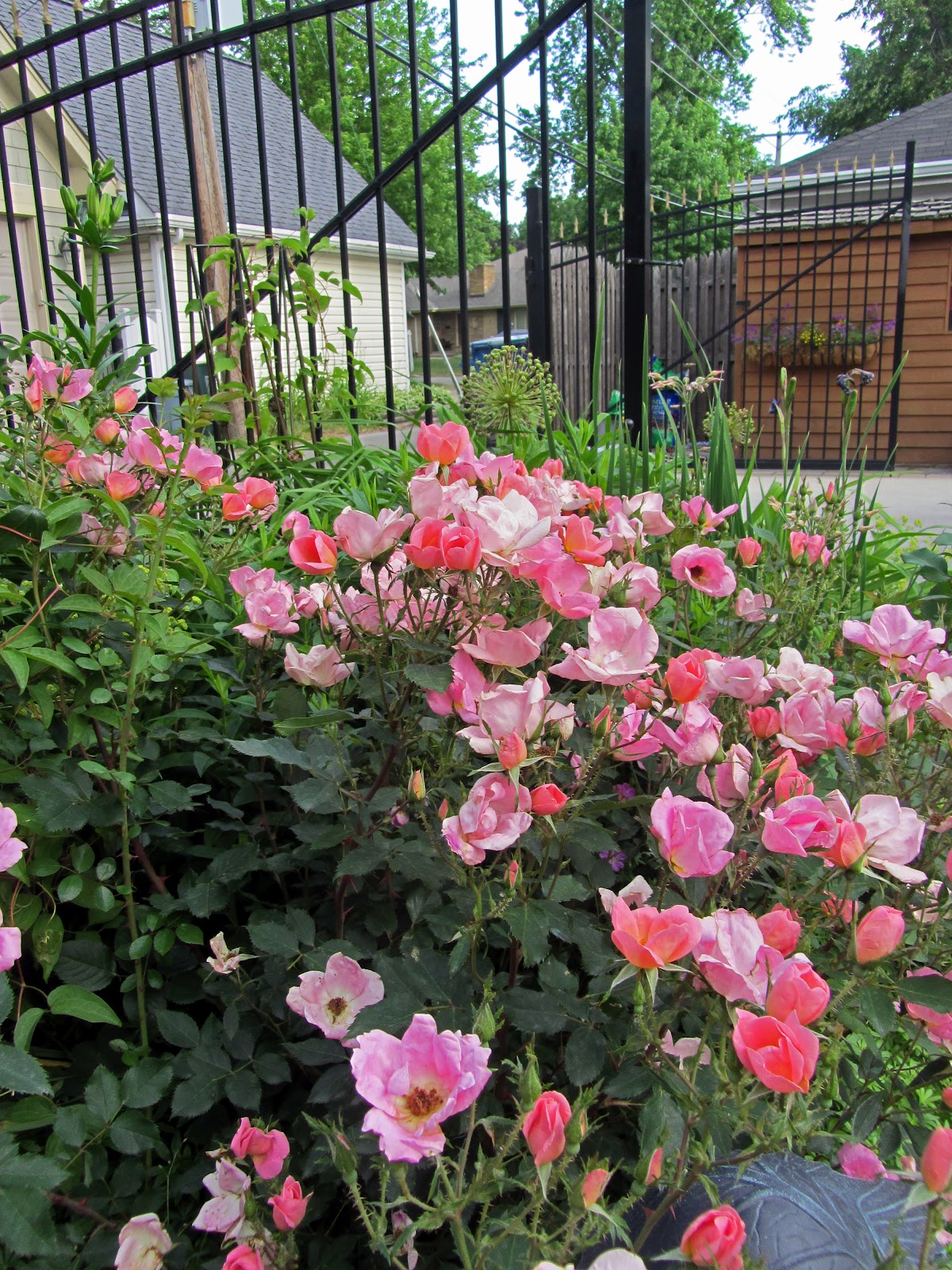
I guess I am a rose person because I have many.  The roses I grow are mostly shrub roses with only one hybrid tea that I have struggled with over the past few years.  It was the Rose of the Year so I figured I had better keep it and try to work it into the garden.

Pink Promise had a little frost bite this year but overall rewarded me with some beautiful fragrant blooms poking through the Becky Shasta Daisies.

Carefree Beauty is a favorite, loose and casual with very large flowers.  It can get a little floppy and I have seen this variety tied to a trellis.

Mary Rose is from David Austin beautiful and fragrant with peony like flowers.

Roses do require pruning and fertilizing if they are going to look their best.  I know they say the shrub roses do not need to be pruned, but I find they sometimes need it the most to remain controlled and to produce multiple flowers.

Carefree Delight is a taller rose that blooms in clusters, great for peeking out over lower growing plants.

Roses look good in the border together and with other green plantings.  Mary Rose, All The Rage  and Carefree Delight are intermingled.

Rainbow Knockout in the back perennial border, the best performing shrub rose ever.  It is the first to bloom in the spring and the last to bloom in the fall.

Rainbow Knockout

You won't see Rainbow Knockout at the shopping malls, although it would have been a great choice.  It has now become difficult to find in my area because the public didn't think it was eye popping enough in the containers.


Double Knockout does better in my area than the single but I grow both.  I prefer the shape of the single one.  You don't have to deadhead but I usually snip off the wilted flowers like the ones in the photo!

Sunny Knockout is the only fragrant Knockout Rose.  However, this one has not been a great performer for me.  It may not like being in the border peeking out.

I have all of the Knockout roses, including Blush, Single Pink, Double Pink and Single Red.

Knockout Blush is a light pink with the petal structure of Rainbow.  I have not seen this one on the market for a few years.

Knockout Double Pink

Single Red Knockout


It is important to note that not all Knockout roses perform the same depending upon the zone in which you live.  The original single red is a beauty but did not do as well in the colder climates as the double red.  The double is more upright and in my opinion does not have as pleasing a shape as the single.


Pink Meidiland is a wonderful rose, tall, light, a free spirit

This rose is difficult to find and I have ordered it from California bare root, has never been a problem.

Cinco de Mayo
This is also a Rose of the Year winner, shrub rose, and looks better this year than ever, subtle smokey tones.

This is Home Run Red, one of roses I trialed last year and so far it is a winner.

Home Run Pink
I think this is my favorite because I like pink!


Roses in the border mixed with later flowering perennials are a great pop of color when the spring perennials are done.  They also help cover up the foliage of the Bleeding Hearts, Daffodils, Tulips, Iris and Allium.

Try some roses in your border!