Monday, May 07, 2012

Rain In The Garden

It rained heavily all last night and it rained all day today.  It has been dismal but the garden loves the attention.

Hycinthoides Blue
I put in three colors last fall, white, pink and blue.  I wondered why Northwind Perennial Farm only had blue when I visited last May, now I know why.  The blue is the color that has the most impact, will be ordering some more blue for the fall.

Amsonia Northwind Select
I purchased three of these last spring at Northwind Perennial Farm (not on the market yet), slow growing, not very noticeable flowers but the fall color is to die for!

Halcyon and August Moon Hosta (both can take sun) with Ghost Fern.  It's all about color not flowers.

This is a hosta that cannot take the sun and I have moved it a few times.  I may be moving it again before it gets scalped by the lawnmower.  I no longer remember the name of it so I can't look up best growing conditions.
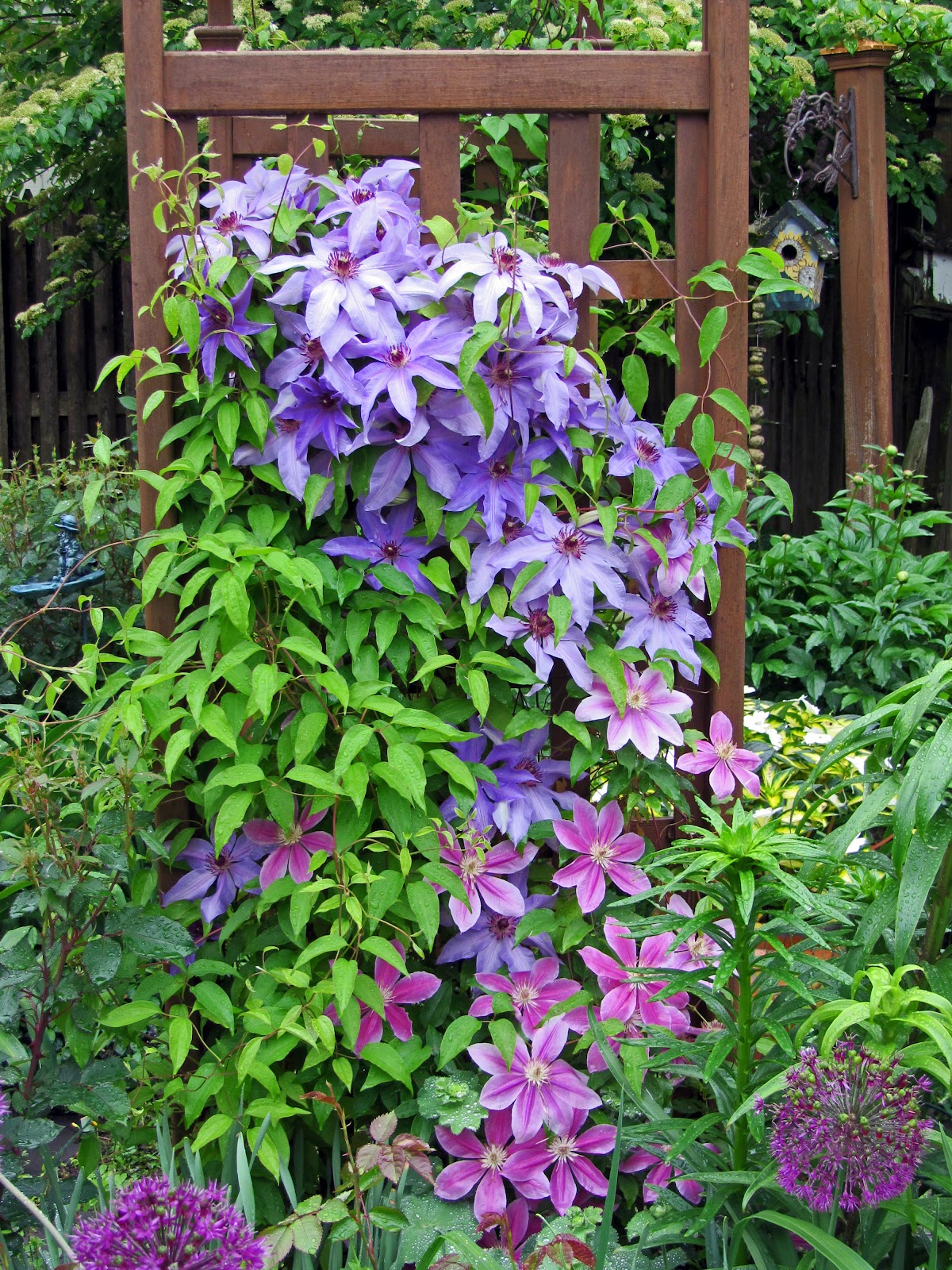
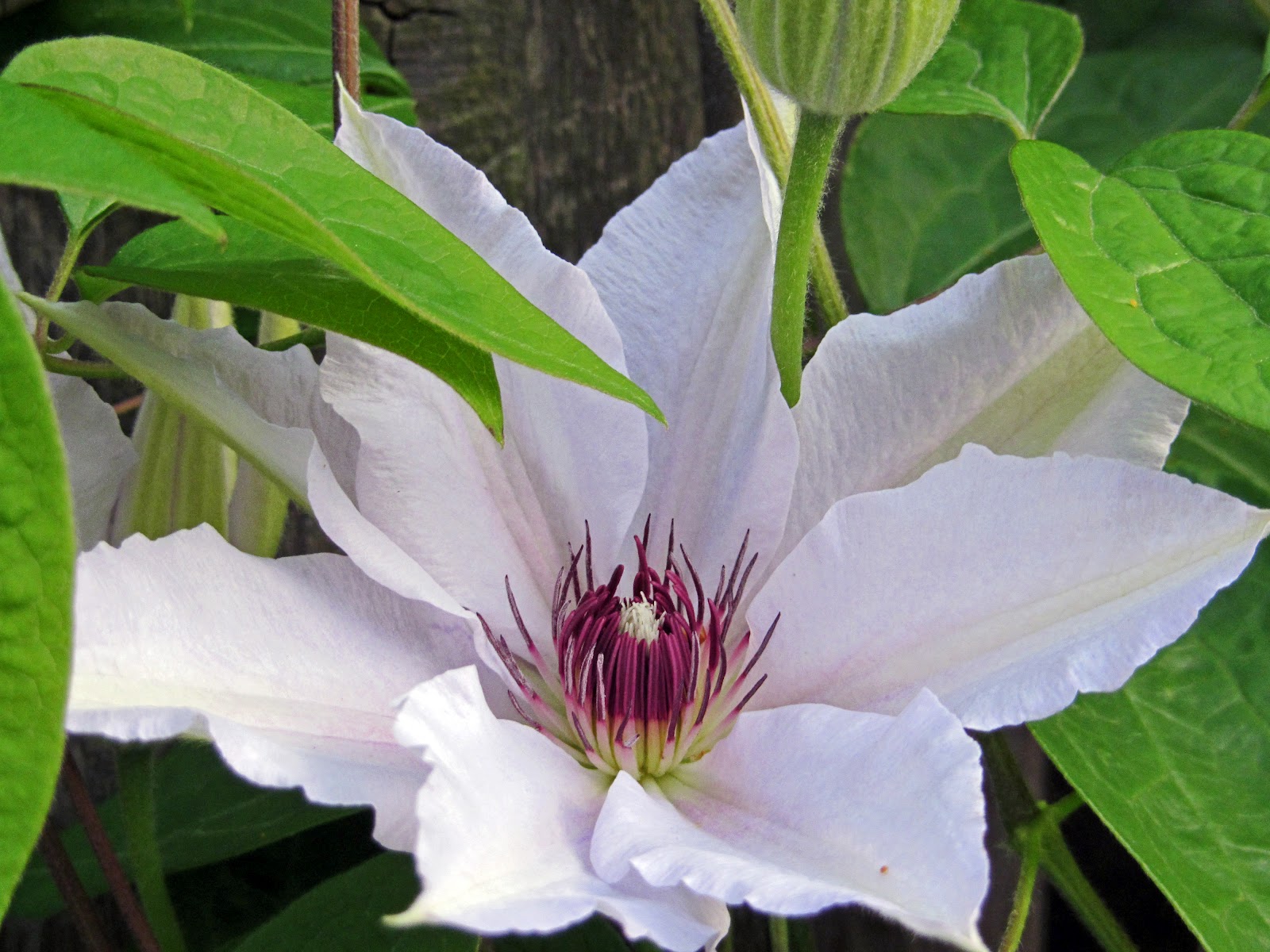
Clematis On The Arbor

Clematis On The Fence

Endless Summer Hydrangea
It got nipped a little by the frost but it has tons of flowerheads this year.  It could be an unusual year but so far the secret is don't cut it down and don't feed it more than a light sprinkle of low nitrogen acid fertilizer.  It is an experiment still in progress!

Weigela Dark Horse
This is ideal for a smaller display growing about three feet wide and tall, again about color.

Heuchera Plum Pudding
This heuchera has never reached it's full growth capacity even after several years.  However last year I moved it away from the daylilies that were directly in front and it seems to be growing larger.  I think it may have just needed its own space.

Ninebark Summer Wine
The ninebark is just getting ready to bloom first pink then turning to white.  It is a beautiful shrub throughout three seasons.  Many of the dark leaved plants look great in the fall when many of the "green" ones start to show wear and tear.

Polemonium Brise d'Anjou (Variegated Jacobs Ladder)
Even if it didn't have a flower it would be a beauty in the garden.  I had many of the solid green ones at my old old house.  I am slowly creating a shade garden under maturing trees with some of my favorite plants.

I ran out several times today to put plants in the ground getting a little wet in the process, but overall if was a good feeling to plant and have nature water them in.

Thursday, May 03, 2012

Around The Garden

It has been really warm again eighty-six degrees and lots of storm warnings.  I don't remember the plants ever being this large and full without the insect damage we see in the summer.  The foliage is lush and the flowers plentiful and huge.

Clematis Fireworks is a Type II and really puts on a show sharing this side of the pergola with Autumn Clematis.  When Fireworks is done I will cut it down to rejunivate and make room for its late summer partner.

Clematis Bee's Jubilee Type II is paired with Fireworks on the other side of the pergola.  It disappeared last year covered by Fireworks, so I had to make sure it had its own area to grow this year.

Dicentra Goldheart is new in the garden and just lights up the area along the fence.

Brunnera Jack Frost is beautiful through three seasons really pops against all of the green foliage and flowers.

Clematis Dr. Ruppel is another Type II and just stunning against the gray of the fence.  This year the rabbits had plenty of food so they did not decapitate the clematis during the winter.  Therefore, the Type II's survived with all of their vines and huge blossoms.

Pagoda Dogwood

Clematis Snow Queen Type II shares the trellis with Dr. Ruppel.  I like to plant more than one clematis on many of my trellises.

Clematis Ville de Lyon is a Type III that I have finally begun treating like a Type II to get it to bloom.  I did not cut it down this year and voila lots of buds and blooms. 

I am giving the Sunpatiens a try this year, saw them last year at Ball Horticultural Test Gardens and was impressed at how well they did out in the open with intense sun.

I have destressed my containers this year with less in them and some simple ones with only a couple of plants, some tropicals and you won't believe it some black.  I don't do black in the garden but somehow black jumped out at me this year for the containers.

Dahlia Lolo
Black leaves, more black to see when I complete the container!

Coleus Sedona and Sweet Potato Vine Black Heart

Oxalis Molten Lava

The Nemesia will not last through the heat in our area.

The radish tops have grown back from the rabbit forage.


I am working on my containers, definitely downsizing in regard to number of containers and number of plants in each container.  Our climate has become so hot in the summer that multiple containers are too labor intensive.  I still have a lot but less than last year!


Thursday, April 26, 2012

Believe It Or Not

It is difficult to believe how much our blooming cycle has been thrown off by the unusual March weather.

I have never had a rose bloom in April!  My roses bloom in June, but not this Rainbow Knockout that looks like it has a little frostbite.

Endless Summer Hydrangea (has not been a good bloomer in my area) has also been nipped but it looks like it has lots of buds this year.  I did not cut it back at all this year and held off on the fertilizer (just a light sprinkle).  This may not be the best year to judge the results because of our milder winter.

Some of the Type 2 clematis are blooming.  This one is Bourbon, grows about six feet high and I will have to cover it again for the patchy frost warning.

This is Ramona and also is a type 2, can't cover this one because it's on the arbor.

Type 2 clematis are a little more work in that they require careful pruning in the spring and every so often need to be cut down after blooming to rejuvenate them and get rid of a lot of dead wood.  I think it is worth growing some of them because of their early bloom and large flowers.

Wow, I have never had this many berries forming on Amelanchier Regent, birds will love it!

Allium in the border takes up hardly any room, a great bulb to layer where there is lots of other foliage to hide the ripening leaves.

I am going to use less annual fillers in the border this year, impatiens are susceptible to downy mildew, and these are what I have usually interplanted.  I am thinking Verbena Bonariensis might work well and take up little space.

I have given up trying to reposition my pansies in other areas, the heat always gets them!

Foolproof perennials, Heuchera Villosa Purpurea, Heuchera Southern Comfort, Heuchera Pistache and Japanese Painted Fern all happy together in part shade.

Raspberry Splash Pulmonaria looks better as the season goes on, decorative leaves all summer.

Persicaria Polymorpha is creeping up towards the grid, hope it holds it firm this year during the storms.  It is such a striking plant and will bloom all summer if not whipped around by the wind. 

The carex grass has just about covered the fencing that keeps it off the path.

This might be the year for Thunderbolt Hosta, not very pretty when there are only two or three leaves.

Rainbow Knockout
It is important to prune your roses each year, opening up the center, taking out all stems that are pencil thin and leaving some thicker and thinner canes.  Don't forget to feed them and they will reward you with gorgeous blooms.  I bring mine down to about twelve inches and they fill out and up beautifully!

Have a wonderful weekend!


Sunday, April 22, 2012

A Cool Morning Trip With Piet Oudolf

It is probably my fifth time going through Piet Oudolf's book Designing With Plants, and each time I find the philosophy overwhelming but I am determined to master it.  I read it all the way up to Wisconsin and even fielded questions from my husband on what it meant to have a plan that didn't look like a plan.

I have tried Dianthus Firewitch at my home with no luck.  It does just great in Wisconsin, don't know why because the temps are not that different but the air sure is, very little pollution and cooler evenings.

Roy Diblik who is part owner of Northwind Perennial Farm has worked with Piet Oudolf on the Lurie Gardens in Chicago's Millennium Park.  Northwind is located in Burlington, Wisconsin which is very close to my Wisconsin home.  I have frequented Northwind many times over the years and have said before that it is the birthplace of Panicum Northwind grass, one of my favorites.  Roy does not have a degree in horticulture and grew up on a small lot in Berwyn, Illinois but he has become one of the most influential plantsman in recent history. 

Nepeta Walker's Low does great up here no splitting in the middle like mine back home in the alley garden.

I cut down Coreopsis Zagreb a few inches so that it will spread and become more bush like, more blooms.

One of the questions my husband asked was could I duplicate a Piet Oudolf garden in my small space.  I had to think about this and stated that I could definitely use his philosophy regarding repeating plants in color, form, structure and mood rather than duplicating the same plants throughout the garden. 

He did a much smaller garden at Midwest Groundcovers in St. Charles, Illinois (where I had a writers workshop in the fall) and it was very impressive.

This pathway leads up to the front door with boxwood, dianthus and daylilies.

The Knockout roses had gone crazy because we didn't come up in time to cut them back for the season.  With the unusually warm weather they had grown to five feet tall in every which way.  I had to make the hard decision to cut them back severely and possibly miss a first flush of flowers.  I did it and fertilized!

The Hidcote Lavender was very overgrown and I usually cut it back to new growth in early spring.  However, with my late arrival this year or should I say early spring this did not get accomplished.  Again, I decided to do it now!

Sedum Autumn Joy has taken over Salvia May Night, will need to move this.

Sedum Vera Jameson does great but there is one along this path that I have replaced twice, must find out what it going on in the soil.

Shasta Daisy Snowcap

This is an example of volcano mulching done by the landscaping company that takes care of the grounds.  The maple tree is stunted so there may also be a problem with the burlap and twine underneath the soil.  The University of Illinois recommends that the burlap be cut away along with the twine when a tree or shrub is planted.  Many times these products do not decompose as we are told by nurseries and landscaping companies.

Echinacea Magnus and White Swan do well in this climate.

All of the plants at this Wisconsin home require minimal amounts of water because we are not always there to take care of them.  Even the Knockout roses survive under these conditions.  I used to put in some annuals but have given up on this as they require more care than the perennials.

I won't be doing too much Piet Oudolf up north but I have incorporated some of his recommendations in regard to preferred perennials.  However, back home, I will work more with his philosophy rather than the planned garden look.