Monday, August 02, 2010

The Last Dance

Can you believe it will be the last time to do certain activities in the garden?  Evergreens should have been trimmed before the end of July because they put out new growth that can be nipped with the first frost.  Frost, what does that mean?  The average first frost for Illinois is the third week of October.

I still have some boxwoods that I am going to take a chance and trim this week because if this weather keeps up we won't have frost until January!  Do not feed any evergreens or shrubs in August in zone 5 or colder - stimulating growth can cause dieback when it turns colder.

Some pretty things to look at as we talk about the end of summer annuals.  This is an unnamed coleus and feathery sweet potato vine.  I wish I had planted this in one of my containers but this was designed for my daughter-in-law for two carefree metal urns by the back door.  They have done great all summer.


My daughter-in-law's front planters are very large 24" cast iron on pedestals, so if your remember the spring plantings, there were lots of plants!

I will feed my roses for the last time within the first two weeks of August.  My Rainbow Knockouts usually bloom until early November.  I do trim all of my roses lightly just to neaten them up, never having a problem with late fall growth.

Annuals still need to be fed every two weeks with a high bloom formula until they succumb to the frost - impatiens, coleus, sweet potato vine, fuchsias and all types of begonias will be the first to go with zinnia, marigolds and dahlias to follow.  Petunias, allysum and geraniums are the last to give up the ghost as they can take some cool temperatures. 


This is Red Velvet Coleus and Yellow Saffron Suberbells and they have not succumbed to our constant heat this summer.


This is Gay's Delight Coleus and it will not hold up to a frost, but in the meantime a great color in the garden.
I will need to bring my tropicals in when the nights begin to drop into the 40's.  I can't believe I am actually saying that temperature.


The red grasses will take over for fall, petunias will hold up to a light frost, sweet potato and coleus will not take a frost, but we will insert some cabbages and decorative pumpkins.


We can make this work into the next season!

Saturday, July 31, 2010

A Bountiful Harvest In a Small Garden

After an early morning heavy rainstorm, I went out to the garden to check the veggies.  Oh, I had two tomatoes, two cucumbers and a few more peppers last week, so I wasn't expecting much.  Voila!  I ventured around the back of the garden and found many more tomatoes than I had seen previously, pulled some carrots (small but we did have them for dinner) cut the basil and picked some more of those pretty hot peppers.


When you pick tomatoes choose various stages of ripeness so that you don't end up with more ripe tomatoes than you can use in a given time frame.  However, this doesn't always work if you have planted tons of tomatoes.  Good luck, I have been there with making every tomato recipe I could find, giving them away to the point where friends and family said they couldn't use anymore!

Keep the basil flowers deadheaded or the plant will go into decline.  I cut quite a bit today and I can't use it right away, so it becomes a decorative arrangement plunged into a pitcher of water.  It will hold for a couple of days until I can make my pesto recipe.  This is a recipe given to me by my daughter-in-law because the children would not eat my pesto but went back for seconds with hers.  Mine was the James Beard adult recipe, a little too strong not only for children but for some adults.

1/4 cup of pine nuts
1 large bunch of fresh basil, no stems
1/2 cup of parmesan cheese shredded
1 clove of garlic
1/2 cup of olive oil

Process in blender or food precessor, store in refrigerator or freeze


Friday, July 30, 2010

The Most Impressive Hydrangeas

This is the time of year the big ones show their stuff!  They do not bloom all summer but when they do, they are show stoppers.


This is Limelight Hydrangea.  I cut it down in March in a semi-circle so that it will bloom throughout the plant and not just on top.  It grows to about 7 feet tall and just as wide.  Limelight enjoys full sun but will bloom in part shade.  Fertilize with an acid fertilizer in the spring and again in the early summer.  The blooms begin a white with a tinge of green, then turn greenish and then pink to rose to tan in the winter.  I cut them at three stages and leave some dried tan for winter interest.  The is a spectacular plant and will draw many comments from those who pass by.


The flowers are large and fluffy, somewhat pendulous but not bending to weigh the plant down.  If not shaped in the spring it will get many blooms on top and tend to look top heavy.


This is Unique Hydrangea and it can grow to eight feet or more.  I shape it to about two feet tall in the spring and it grows to about six feet on my tight north side of the house.  I love this one, it is so Victorian, white, then white with pink then rose.  It is unusual because it has many seed heads showing amongst the florets.


The panicles are about twelve inches long and last for years when they are dried.


This is my daughter-in-law's Pink Diamonds Hydrangea.  We shaped it in the spring because it had been let go to the point where there were only blooms at the top.  It will probably take another year before it is a full shape with flowers throughout.  It is more upright than Unique, not as pendulous, flowers not as large, but does go through the full range of colors until the end of the seasons.


You can have beautiful hydrangeas with the proper shaping and feeding.  All of the above hydrangeas grow on old and new wood so it can only help each year to cut out any dead branches, not to worry about bringing them down to a size that will work on your property, don't forget to feed!


Wednesday, July 28, 2010

Let's Heat Things Up!

You have got to be kidding!  This year has been a wake up call for me in regard to plants that can withstand the intense heat we have had for most of the summer.  Granted, each and every summer is different and not like this one, but we must think in terms of planting what will hold up in our gardens if we have this type of weather.
Pennisetum Hamlin


Believe it or not, but the plants that are surviving this heat are impatiens, followed quickly by coneflowers, zinnias, succulents, sedums, agastache, centranthus, nepetas, verbenas, fibrous begonias, lantana, coleus and of course daylilies.  The phlox has suffered browning leaves and the petunias bought in pre-planted containers have dried up.  The petunias that I planted in my own containers have done much better.  The geraniums have ceased to bloom in this heat, however, the ones that I mossed the top of the containers are reviving and setting buds

Grasses usually love this weather, even the carex on the north side of my home is flourishing.  Hydrangeas are into the wilts and will require extra water as well as the ferns, astilbes and hostas.  The rose bushes look good and do not go into the wilt mode easily.  However, they are continually attacked by insects during this type of weather.
Miscanthus Udine

I will definitely become more aware of plants that will withstand the heat, repel insects and still add color to the garden.  Here are a few:  Grasses, Agastache, Gailladaria, Verbenas, Lantana, Sedums, Nepetas, Coneflowers, Penstemons, Agaves, Daylilies, Dianthus (Firewitch) and many more.  Check out http://www.highcountrygardens.com/ for more ideas.  I am seriously thinking of making the south side of my home into a completely succulent garden.  Xeric plants are not plentiful in my area because intense, prolonged hot weather is not typical.  However, in the past years I have put more and more of these waterwise plants into my garden.

Coleus with Bronze Sweet Potato Vine


Lemon Twist Coleus
I will never again plant a dahlia!  I know this sounds drastic, but I have more bad looking dahlias this year than any other plant I can remember.  Although, maybe it depends on the variety because the large ones that I have in the ground look good (except the insects love them).  We do not seem to have the climate for this plant.  I remember my friend from Scotland whose husband was a dahlia expert, crossing them and growing them each year he was in the United States.  I now appreciate his expertise to make it work.

Coleus Inky Fingers
Even my Dianthus Firewitch has had a problem here this year, but not in Wisconsin.  Mine on the south side of my home is in it's first  year and maybe could not take the heat.
Gaillardia Arizona Sun
Gaillardia Mesa
Lantana
Phlox Eva Cullum


Fibrous Begonia
Agave
Impatiens with Coleus

Border with Impatiens

Petunias in Hayracks on North Side


Verbena Great Expectations (purple) blooms all summer with deadheading.


Sedum Autumn Joy almost prettier than when it turns red


Nicotiana Alba

Coneflower Magnus

Sunday, July 25, 2010

The Good, The Bad And The Ugly

I know, another movie but somehow a lot of movie titles apply to gardening.  The good is that we had  rain up to eight inches in twelve hours. We really needed rain because of the prolonged heat and dryness.  The bad is that the rain was torrential, many streets flooded, whole communities were shut down as were parts of the expressway, power outages and flooded basements.  The ugly is what many of us have left in our gardens, irretrievable plants that I will have to cut down, whipped grasses and fallen tomato plants.

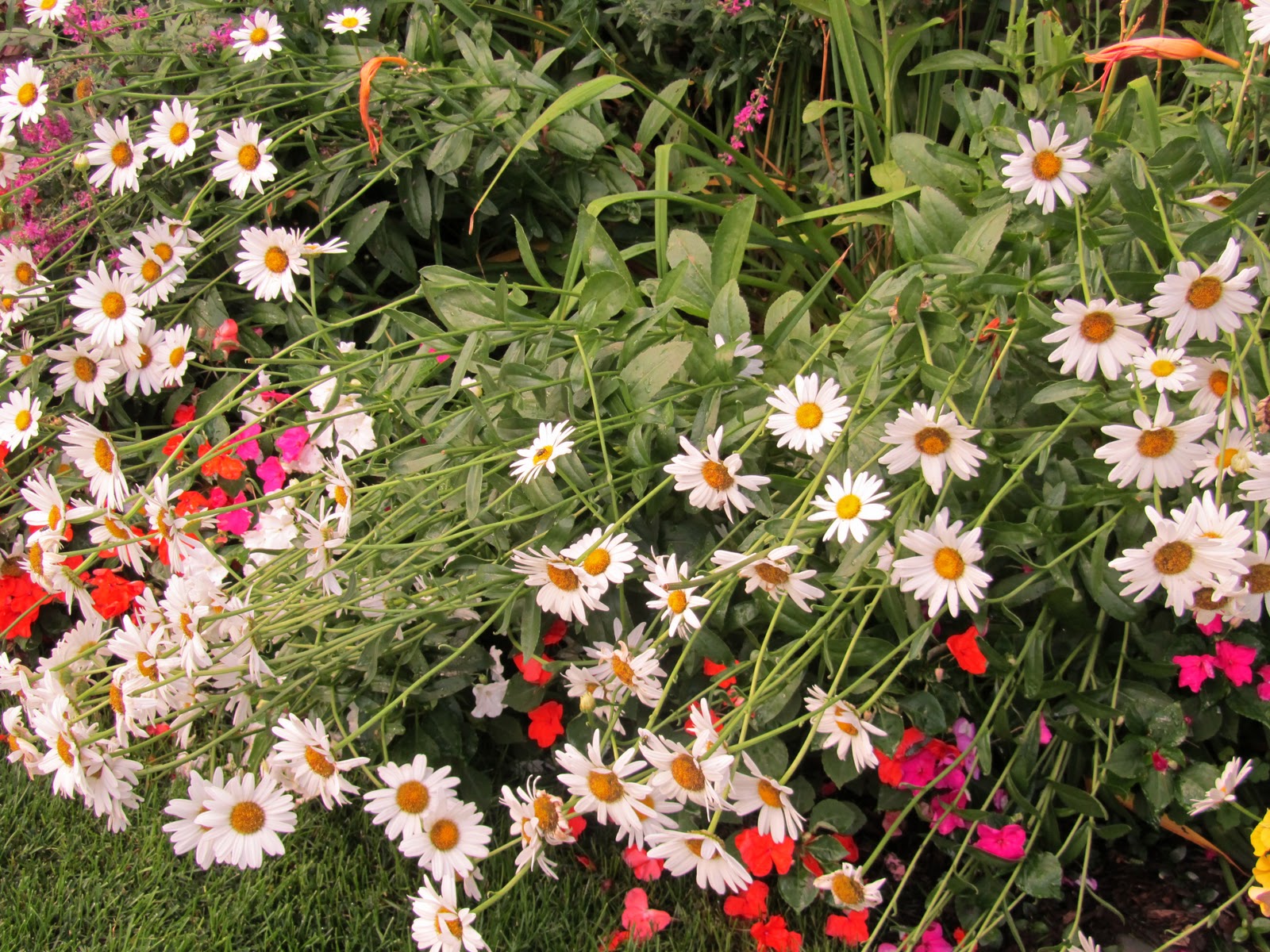
These Beckys did not look too bad but when I went to prop them up many of the stems were broken.

Becky in the front was a little further along so I was almost ready to cut back even before the storm.

I still have some pretty blooms left that have survived but most everything looks a little beat up.  Guess what, the Japanese beetles survived still chomping away on my rose buses, dahlias and numerous other goodies
This cucumber trellis from Gardener's Supply is working!
  
The Dura Cage could not hold up to the weight of the Beefsteak tomato.  Because it is made of plastic, the legs broke under the weight.  It is a great design, but the material is not suitable to hold up the large tomatoes.  I will contact the company and let them know they have a good idea with the wrong material.

Variegated Heliopsis loves the heat and certainly didn't mind the rain.

Tetrina's Daughter weathered the storm.


Heuchera Villosa Purpurea
The flowers are lovely but they got hit hard also.  I just can't cut them yet.

Pink Knockout
I will have my work cut out for me the beginning of the week, mostly cutting down the Becky Shastas (they were so big they just could not withstand the downpours).  I am really wrapping my mind around fall right now, bought some fake pumpkins at the craft store to ready them for container decorations.  I cannot use real pumpkins because the squirrels instantly eat them.  If you spray the fake ones with marine varnish, they hold up very well outside.  Don't worry, I am not putting them out in July or even August!
Lemon Queen Heliopsis